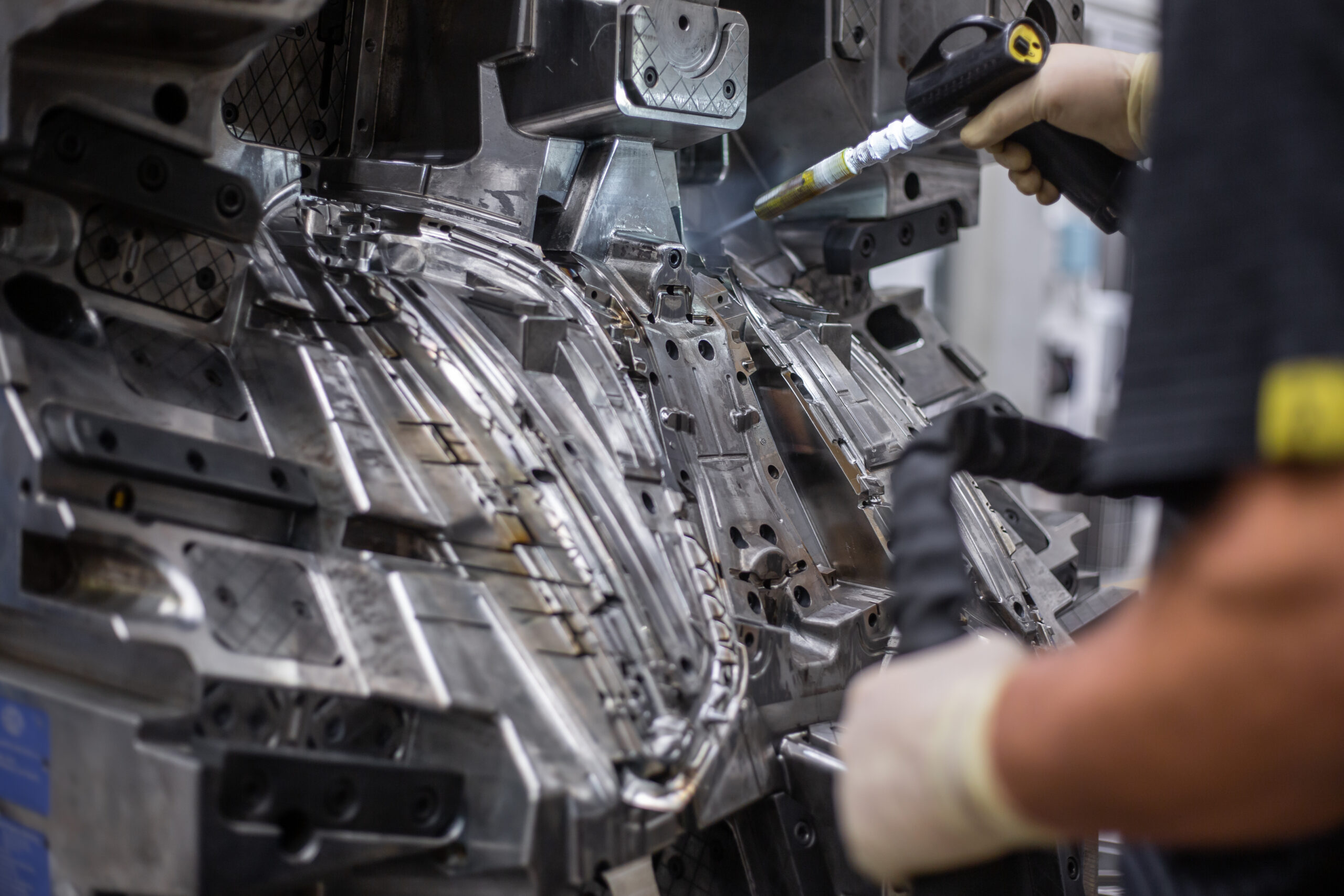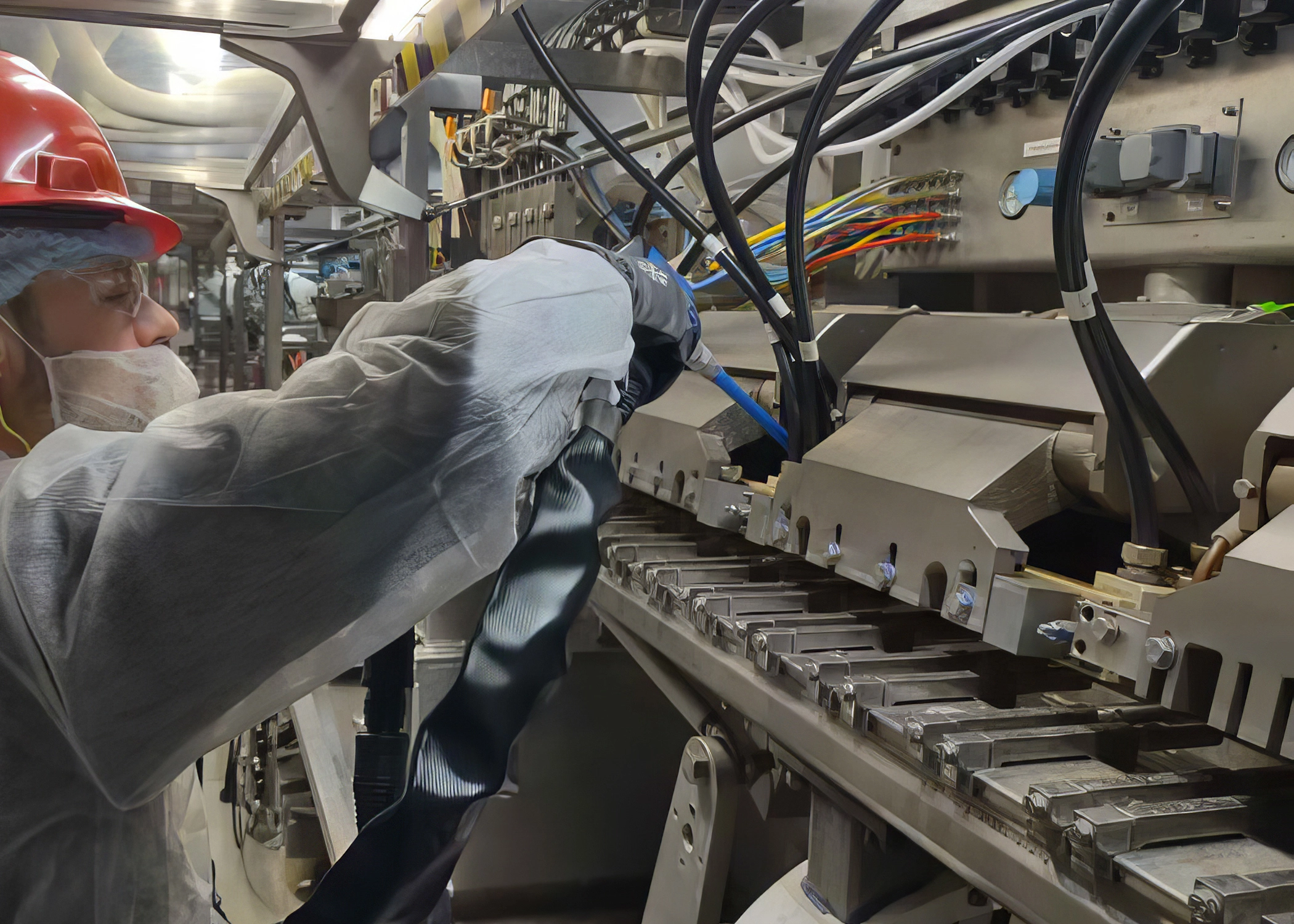

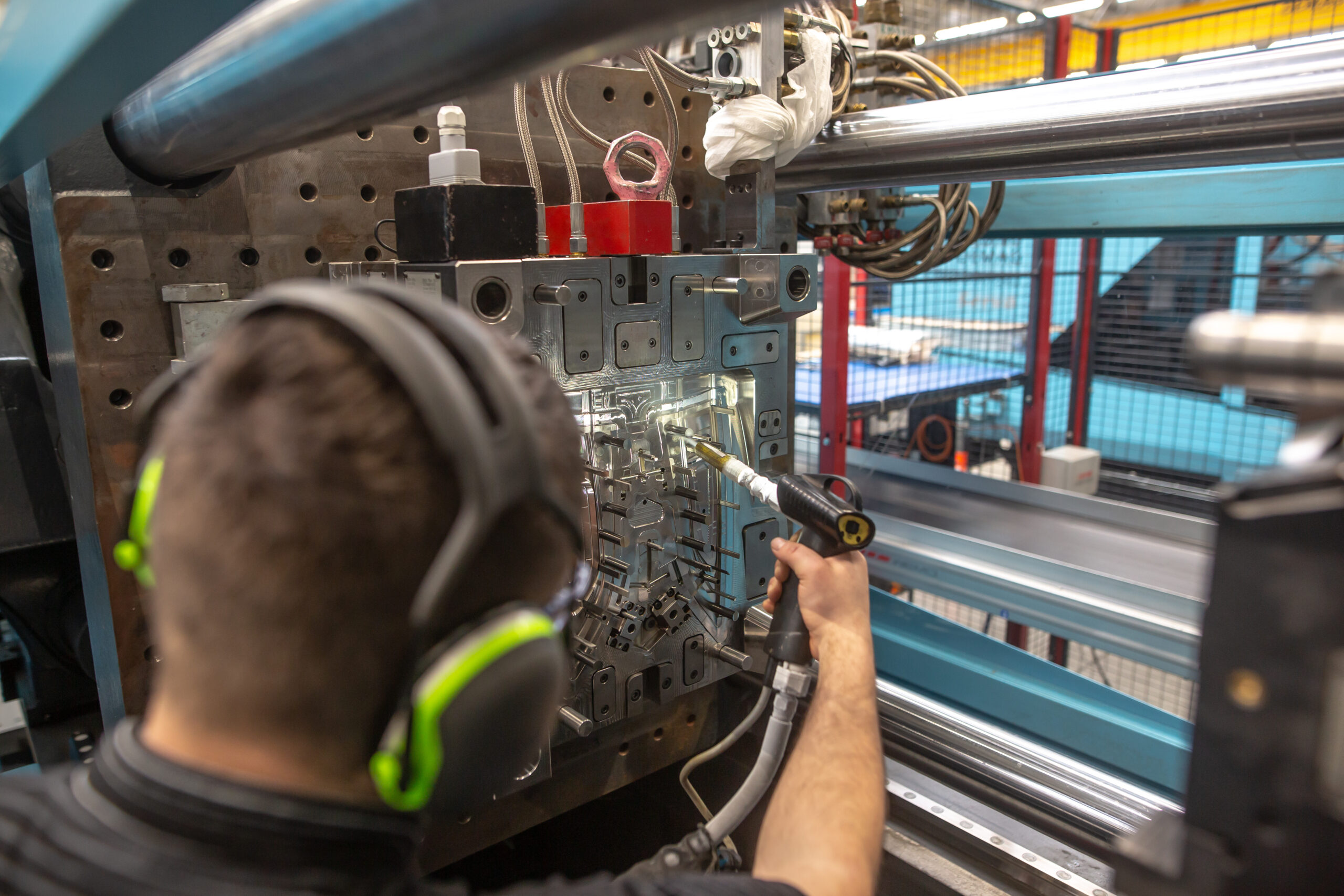
Every injection molder knows the math. A dirty mold produces bad parts — flash, surface defects, dimensional drift, knock-outs. And every hour that mold is offline for cleaning is an hour of lost production that can cost anywhere from $5,000 to $50,000 depending on the press, the part, and the customer waiting on delivery. Dry ice blasting for injection mold cleaning is a uniquely positioned method to address this challenge.
For decades, the options for cleaning injection molds have been limited to the same set of trade-offs: chemical solvents that introduce safety and disposal headaches, wire brushes and scrapers that wear down precision surfaces, or abrasive media blasting that risks altering tolerances on tooling worth tens or hundreds of thousands of dollars.
Dry ice blasting changes the equation entirely. And plastics manufacturers across Indiana and the Midwest are increasingly making the switch — not because it’s new technology, but because the operational and financial case has become impossible to ignore.
What Dry Ice Blasting Actually Does
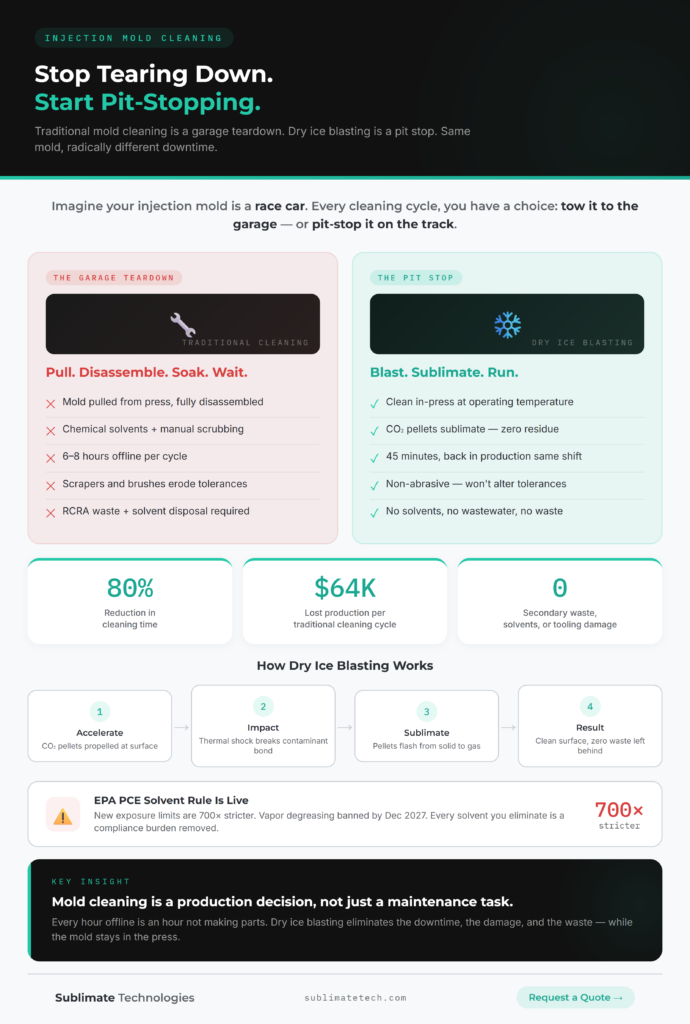
Dry ice blasting uses compressed air to accelerate solid CO₂ pellets at the surface being cleaned. On contact, the pellets sublimate — they convert directly from solid to gas — creating a rapid thermal differential that breaks the bond between the contaminant and the substrate. The contaminant lifts off. The dry ice disappears. Nothing is left behind except what was removed.
That sublimation property is what separates dry ice blasting from every other cleaning method available to mold shops. There is no secondary waste stream. No blast media to clean up. No chemical residue to manage. No water to dry. The only thing left on the floor is the contaminant itself.
Why This Matters for Injection Mold Shops
The operational advantages of dry ice blasting for mold cleaning aren’t theoretical. They’ve been documented across thousands of plastics facilities worldwide, from Tier 1 automotive suppliers to custom molders running tight-tolerance medical components.
**Cleaning time drops by up to 80%.** Traditional mold cleaning requires pulling the mold, disassembling it, soaking or scrubbing components, drying, reassembling, and reinstalling. Dry ice blasting can be performed with the mold still in the press, at operating temperature. A cleaning cycle that took a full shift can be completed in under an hour.
**Zero tooling damage.** Dry ice is softer than the metals and coatings used in injection molds. It won’t scratch, pit, or erode parting lines, shut-offs, or textured surfaces. For shops running molds with tight tolerances — especially those with EDM textures, polished finishes, or thin-walled core pins — this is the single most important advantage. Wire brushes and abrasive media cannot make the same claim.
No chemical solvents. No secondary waste.** With the EPA’s recent restrictions on perchloroethylene (PCE) and tightening OSHA exposure standards for industrial solvents, every chemical you eliminate from your cleaning process is a compliance burden you no longer carry. Dry ice blasting requires no solvents, generates no wastewater, and produces no RCRA-regulated waste streams. Your EHS team will notice the difference immediately.
Clean at operating temperature. This is the detail that changes the production math. Because dry ice blasting doesn’t require the mold to cool down, you can clean between production runs without the thermal cycle that shortens mold life and extends changeover time. For shops running multi-cavity molds on tight delivery schedules, cleaning at temperature means more uptime and less thermal stress on the tool.
The Cost Conversation Most Shops Aren’t Having
When maintenance managers evaluate mold cleaning methods, they typically compare direct cleaning costs — the price of solvents, media, labor hours, and contractor fees. But the real cost of mold cleaning isn’t the cleaning itself. It’s the downtime.
Consider a typical scenario: a 4-cavity mold running automotive interior parts on a 500-ton press. The mold needs cleaning every 30,000 shots due to gas residue and material buildup. Traditional cleaning takes the mold offline for 6–8 hours. At a conservative $8,000 per hour in lost production value, that’s $48,000–$64,000 in opportunity cost per cleaning cycle.
Now compare: dry ice blasting that same mold in-press in 45 minutes to an hour. The production line is back running the same shift. The opportunity cost drops to near zero.
Over the course of a year, a shop cleaning 10–15 molds on a monthly rotation can recover hundreds of thousands of dollars in production capacity — capacity that was always there, locked behind cleaning downtime.
That’s before factoring in extended mold life from eliminating abrasive cleaning damage, reduced scrap rates from cleaner mold surfaces, and the elimination of solvent procurement, storage, and disposal costs.
The Regulatory Tailwind- EPA PCE Solvent Ban
The economics alone are compelling. But there’s a regulatory dimension that’s accelerating adoption.
The EPA finalized its risk management rule for perchloroethylene (PCE) in December 2024, setting an Existing Chemical Exposure Limit more than 700 times stricter than OSHA’s previous standard. Vapor degreasing with PCE — one of the most common industrial cleaning applications — is prohibited as of December 2027. Remaining industrial uses face full prohibition by December 2034.
For mold shops still using solvent-based cleaning methods, the compliance infrastructure required to continue — inhalation monitoring, respiratory PPE programs, regulated work areas, self-certification — represents a significant and growing cost. And it’s an investment in a method that has an expiration date.
Dry ice blasting sidesteps the entire regulatory framework. No solvents means no exposure monitoring, no chemical management programs, and no hazardous waste disposal obligations. It’s not just a better cleaning method — it’s a cleaner regulatory posture.
What It Looks Like in Practice
We work with injection molding shops across Central Indiana and the Midwest. A typical engagement starts with a single mold — usually one that’s been a persistent maintenance headache, where traditional cleaning hasn’t been keeping up with residue buildup or where the shop has been dealing with escalating scrap rates.
We bring the equipment to your facility, clean the mold in-press at operating temperature, and document the results with before-and-after photography and a cleaning report. For shops that see the value — and they almost always do — we build a recurring maintenance schedule that aligns with your production calendar.
Whether it’s gas residue clogging vents, mold release buildup on parting lines, polymer flash on shut-offs, or carbon deposits on hot runner manifolds — the applications span virtually every surface and component in an injection mold. We’ve cleaned textured cavities, polished cores, ejector assemblies, and thermoforming tools, all without altering the geometry that makes the part spec-compliant.
The Bottom Line
Mold cleaning is a production decision, not just a maintenance task. Every hour your mold spends offline for cleaning is an hour it isn’t making parts. Every scratch from a wire brush or blast media is cumulative damage to a high-value asset. Every drum of solvent is a compliance liability that’s only getting more expensive.
Dry ice blasting eliminates the downtime, the damage, and the waste — and it does it while the mold is still in the press.
I spent years in federal environmental enforcement before founding Sublimate Technologies. The pattern is always the same — regulatory pressure builds, costs compound, and the facilities that moved early are the ones that aren’t scrambling when deadlines arrive. The solvent-to-dry-ice transition in plastics manufacturing is following that exact trajectory.
If you’re running injection molds in Indiana or the Midwest and haven’t evaluated dry ice blasting for your mold cleaning program, we’ll show you the results on your own equipment so you can make the comparison yourself.
Request a quote from Sublimate Technologies to see what dry ice blasting can do for your mold maintenance program.